


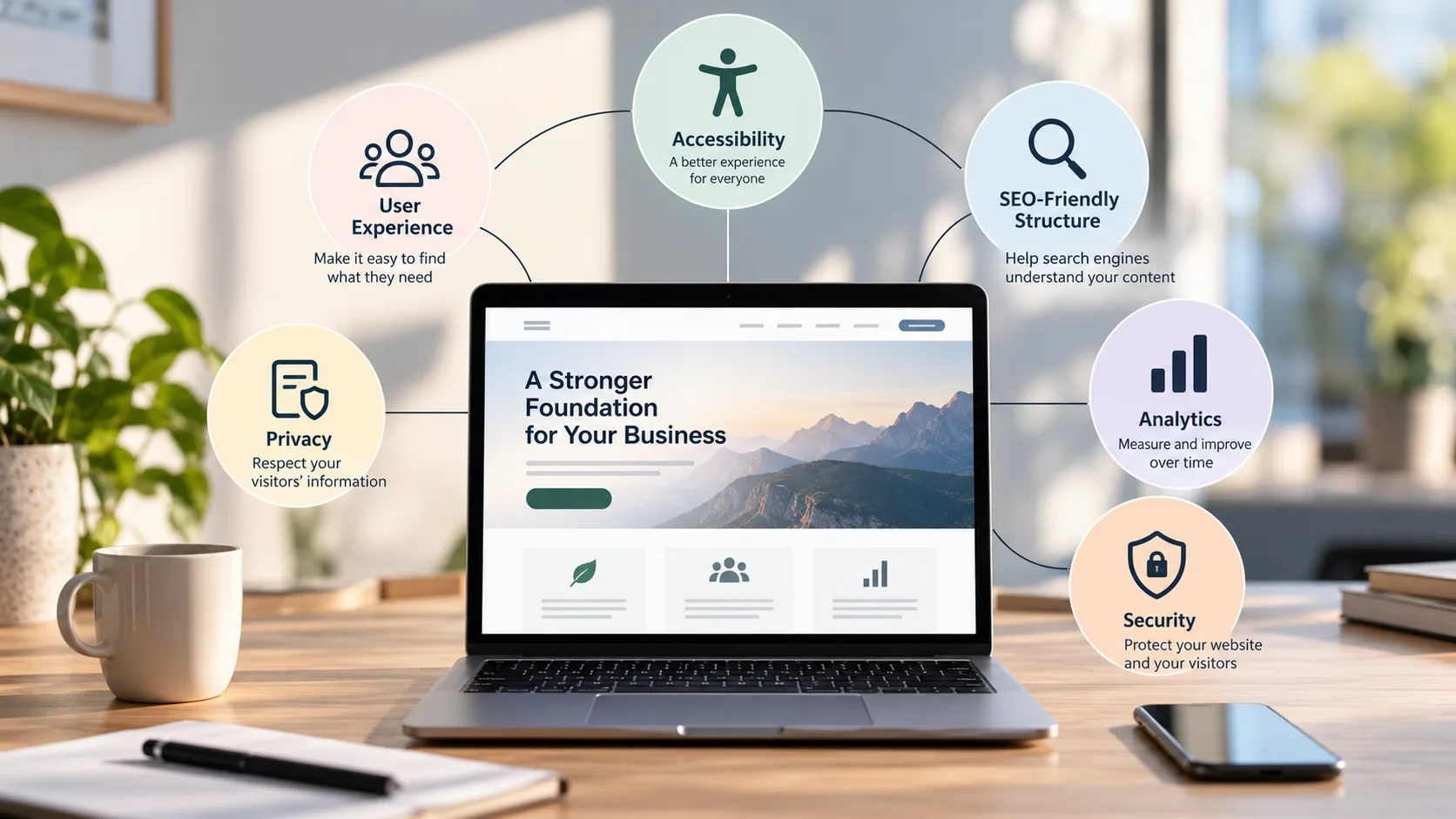
A successful website needs more than an attractive design. It should be easy to use, accessible, discoverable, measurable, respectful of privacy, and secure.
Ongoing SEO, content development, and other digital marketing services are important long-term strategies for growing a business. Whether you’re developing a new website, redesigning an existing one, or rebuilding a website without changing its appearance, getting these six fundamentals right from the beginning creates a strong foundation for future marketing efforts.
1. User Experience: Don’t Make People Think
Steve Krug’s book, Don’t Make Me Think, captures one of the most important principles of website development: people shouldn’t have to work hard to figure out how to use your website.
When someone lands on your website, they should quickly understand what you offer, who it’s for, and whether your product or service is the right solution for their needs. Visitors shouldn’t have to search through multiple pages or decipher vague marketing language to figure out how your business can help them. Once they recognize that they’re in the right place, your website should make it easy to take the next step, whether that’s learning more, contacting you, scheduling an appointment, or making a purchase.
Donald Miller, author of Marketing Made Simple, puts it simply: “Never forget: If you confuse, you’ll lose.” Confusing navigation, too many choices, broken buttons, and slow-loading pages create friction and increase cognitive load—the mental effort required to understand and use a website.
Good user experience reduces that effort through clear messaging, intuitive navigation, logical content organization, readable text, fast-loading pages, and interactions that work as expected. The goal is to help visitors quickly recognize the value of what you offer and accomplish what they came to do without unnecessary frustration.
2. Accessibility: A Better Experience for Everyone
Accessibility is part of user experience, but it’s important enough to deserve its own consideration. A website should be usable by people with different abilities, including those with visual, auditory, physical, and cognitive disabilities.
My father was color blind, but I didn’t know that until I was an adult. It’s a reminder that disabilities aren’t always obvious, even among people we know well. Something as simple as using color alone to communicate information can make a website difficult for someone with color vision deficiencies.
Accessibility improvements often benefit everyone. When I was a kid, we sometimes had to pop wheelies on our bicycles to get onto sidewalks without curb ramps. It was fun but also a little dangerous at times. Those ramps improve accessibility for people with mobility challenges, but they also benefit cyclists, parents pushing strollers, and delivery workers. The same principle applies to websites.
Captions help people who are deaf or hard of hearing, but they’re also useful when watching videos in noisy environments or when you’re at work. Clear headings make content easier to navigate with screen readers and easier for everyone to scan. Good color contrast improves readability for people with low vision and those viewing screens outdoors.
Building an accessible website means considering keyboard navigation, descriptive links, properly labeled forms, sufficient color contrast, and meaningful alternative text for images. The Web Content Accessibility Guidelines (WCAG) provide a framework for these practices.
An accessible website removes barriers so more people can use your website.
3. SEO-Friendly Structure: Help Search Engines Understand Your Content
Search engine optimization involves much more than website development, but a website should be built with an SEO-friendly foundation from the beginning.
Search engines use automated crawlers to discover and understand website content. Proper heading structures, descriptive page titles, meaningful URLs, internal links, and appropriate image alternative text help these systems interpret your pages.
For example, headings shouldn’t simply make text larger or bolder. They should organize information logically, making content easier for visitors, screen readers, and search engines to understand.
With the growth of artificial intelligence, websites are also being accessed by more AI-powered systems. While different crawlers serve different purposes, clear content organization and semantic HTML can make information easier for many automated systems to interpret.
This is another example of how accessibility and SEO work together. Many practices that improve accessibility also help search engines understand your content.
A technically sound website doesn’t guarantee high rankings or AI recommendations, but it removes unnecessary obstacles and creates a better foundation for ongoing SEO efforts.
4. Analytics: You Can’t Improve What You Don’t Understand
If your website is intended to generate leads, sell products, encourage donations, or communicate information, you should have a way to measure whether it’s accomplishing those goals.
Google Analytics helps you understand visitor activity and important actions. Google Search Console provides insight into how your website performs in Google Search. I also like Microsoft Clarity, which offers heatmaps and session recordings that can help identify where visitors encounter difficulties.
For example, if visitors repeatedly click an element that isn’t interactive, there may be a design issue. If people visit your contact page but rarely submit the form, it’s worth investigating whether the form is confusing, too long, or simply unnecessary for their needs.
Analytics doesn’t automatically tell you what to change, but it helps you ask better questions and make more informed decisions. These tools should also be configured with appropriate privacy protections.
A website is never truly finished. Business needs change, visitors behave differently than expected, and opportunities for improvement emerge over time. Even if ongoing testing isn’t part of the initial project, the website should be built so performance can be measured and improved.
5. Privacy: Respect Your Visitors’ Information
Websites often collect personal information through contact forms, newsletter subscriptions, analytics tools, advertising pixels, and third-party integrations. Some information is provided directly by visitors, while other data, such as IP addresses and browsing activity, may be collected automatically.
Privacy laws, including California’s Consumer Privacy Act (CCPA) and Europe’s General Data Protection Regulation (GDPR), establish requirements for handling personal information. California has also seen litigation involving website tracking technologies under the California Invasion of Privacy Act (CIPA).
Not every law applies to every business, and requirements vary. However, website owners should understand what information their websites collect, why it’s collected, and who receives it.
An accurate privacy policy is an important starting point, but it isn’t enough by itself. Websites may also need appropriate consent or opt-out mechanisms, particularly when using analytics, advertising pixels, and other tracking technologies.
Privacy should be considered when building the website, not after tracking tools have already been installed. Being transparent about data collection and limiting unnecessary tracking demonstrates respect for your visitors and helps establish trust.
6. Security: Protect Your Website and Your Visitors
Website security protects your business, your visitors, and your reputation. A compromised website can expose customer information, interrupt operations, or distribute malicious content.
Security begins with good development practices. For WordPress websites, this includes keeping software updated, using trusted plugins and themes, enabling strong authentication, and limiting user permissions. Someone responsible for publishing articles, for example, generally doesn’t need administrator access.
Choosing a reliable hosting provider is equally important. Look for hosting that offers strong security practices, website isolation, dependable technical support, and automated daily backups. Isolation technologies, including containerization, help reduce the risk of a compromised website affecting others on the same hosting infrastructure.
Backups should be stored securely and periodically tested to ensure they can be restored. HTTPS, multifactor authentication, and ongoing software maintenance provide additional layers of protection.
No website can be guaranteed completely secure, but thoughtful development, responsible hosting, and regular maintenance significantly reduce unnecessary risks.
How These Six Considerations Work Together
These six considerations aren’t independent of one another. They reinforce each other and contribute to a better website.
Accessibility practices, such as logical headings and descriptive links, improve user experience while helping search engines understand content. Analytics can reveal opportunities to improve usability, but collecting that information must be balanced with privacy. Security protects the information visitors entrust to your business, reinforcing the confidence established through responsible privacy practices.
There’s an expression I’ve heard many times: “How you do anything is how you do everything.” While that may not always be true, I think there’s value in the sentiment.
Your website is a reflection of your business. Visitors may not recognize the technical details behind an accessible, secure, well-structured website, but they experience the results. When information is easy to find, everything works as expected, and their privacy is respected, it communicates attention to detail and professionalism.
That same attention to detail may influence how they expect to be treated as customers.
Build the Foundation First
Good design, compelling content, and effective marketing are important, but they work best when supported by a strong website foundation.
User experience, accessibility, SEO-friendly structure, analytics, privacy, and security should be considered from the beginning, whether you’re building a new website or improving an existing one.
These are the principles that guide website development at Emphasis LA. Sometimes that means a complete redesign. Other times, it means rebuilding an existing website without significantly changing its appearance.
Either way, the goal is the same: build a website that works well for visitors, supports your business, and provides a strong foundation for the future.